A Clearer Carry-On Toiletry Checklist
A practical carry-on toiletry checklist that starts with your real routine, keeps products visible and leaves room for the security rules that apply to your itinerary.

Carry-on packing gets easier when the checklist is based on use, not on the size of your bathroom cabinet. Start with the products that matter every day, then adapt the container size and format to the trip.
Build the checklist around use
Divide your routine into three moments: morning, shower and evening. Place each product under the moment where it is used. Anything that appears more than once is probably part of the core kit. Anything that appears only as a remote possibility is a candidate to leave at home.
This method is more reliable than a generic “travel essentials” list because it reflects your actual behavior. A person who never uses hair styling product does not need it simply because a packing checklist says so.
Separate essentials from optional items
Create two columns. The first is core: products that keep the routine functional. The second is optional: products that improve comfort but are not essential to the trip.
Pack the core column first. Only add from the optional column if there is a clear reason and enough space. This gives advertising-driven “more is better” packing advice a useful counterweight: a lighter bag is often created by subtraction.
Match products to container formats
Use bottles for compatible liquids and lotions, jars for compatible creams or products that are easier to scoop, and sprays only when the formula works with a spray mechanism. Do not decant products that should stay in their original packaging.
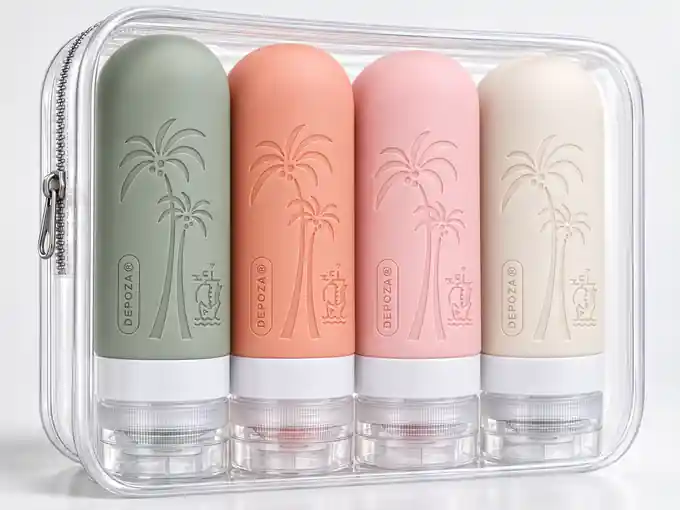
The DEPOZA 4-Bottle Travel Set is intended for a compact liquid routine. If you regularly carry multiple creams, sprays and small accessories, the 20-Piece Travel Kit provides more formats.
Prepare for airport rules
Do not treat a product page, old infographic or social post as the final authority on what can pass through security. Requirements can vary by jurisdiction, airport and itinerary and can change over time.
That extra check is especially important for medication, specialty personal-care products and anything that might be treated differently from ordinary toiletries.
Pack for access
The best carry-on system is easy to reach. Keep the toiletry pouch in a predictable location rather than buried under shoes or dense packing cubes. A visible pouch also makes it easier to verify the contents before closing the suitcase.
Labels matter. Similar-colored liquids can be impossible to distinguish at a glance, especially when the bottles are opaque. Label the product name or routine step when there is any ambiguity.
A sample checklist
- Facial cleanser
- Shampoo
- Conditioner
- Body wash if it is not provided at the destination
- Moisturizer or lotion
- Toothbrush, toothpaste and floss
- Deodorant
- Hair or shaving essentials that are part of your normal routine
- Any trip-specific treatment or prescription kept according to its own instructions
Use this as a starting structure, not a rule. The right checklist should become shorter and more accurate after every trip. If an item returns home untouched twice, question whether it belongs in the standard kit.
For a compact starting point, browse travel bottles. For a broader routine with multiple container formats, compare the travel kit system.
Pack the routine,
not the packaging.
Build a smaller, repeatable toiletry routine around refillable formats.
Shop the system